

Last Updated: November 2, 2026
Quick Summary
You should replace old windows when failures are structural or recurring, such as soft or rotted frames, water intrusion, broken glass, or windows that will not lock. Isolated first-time problems like worn weatherstripping or one fogged unit are usually worth repairing instead. Age combined with a failure also moves the decision toward replacement.
- Run a hand test, dollar-bill test, open-and-close test, frame probe, and glass check on every window.
- Wood windows typically last 15-20 years, vinyl 20-25, aluminum 20-30, and fiberglass 25-30.
- Treat soft sills and recurring water stains as urgent regardless of the window's age.
- Replace when the repair quote exceeds roughly a third to half of replacement cost.
- Tackle safety and water issues first, then group Tier 2 windows by room to lower per-window cost.
Table of Contents
- Start With a Room-by-Room Window Inspection
- Signs You Need New Windows: A Numbered Checklist
- How Long Do Windows Last? Lifespan by Material and Climate
- Window Repair vs Replacement: A Decision Framework
- What Replacement Costs and Energy Savings Actually Look Like
- Prioritizing Replacements by Urgency
- Book a Free Window Consultation With Dunn Wright's Exteriors
- Frequently Asked Questions
Start With a Room-by-Room Window Inspection
Many homeowners wait for a window to fail before thinking about replacement. A window rarely dies overnight, it often signals failure for months before the glass fogs or the frame softens.
Knowing when to replace old windows comes down to catching those signals early: a slow leak of heated air, a sash that sticks more each winter, a thin line of moisture between panes.
Below is a repeatable inspection you can run in an afternoon to help you tell a simple repair from a replacement candidate.
The Five-Minute Check Most Homeowners Skip
Walk each room and run the same four tests at every window. Record results on a simple grid: window location, test result, and severity (minor, moderate, severe).
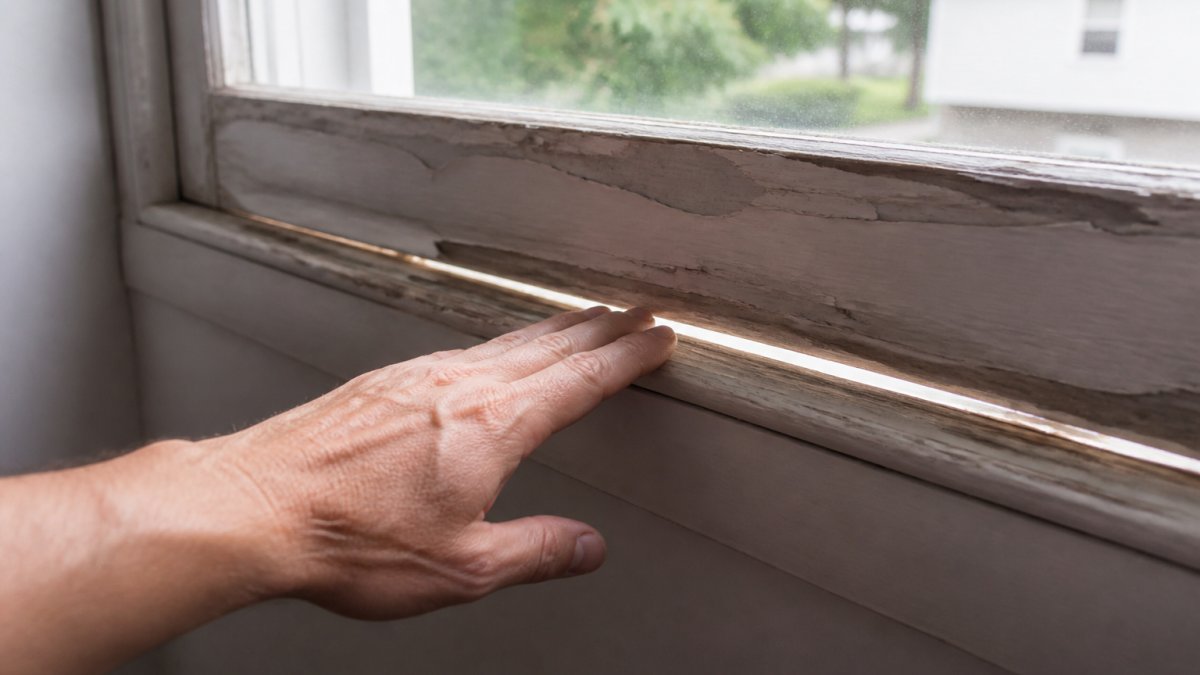
- The hand test for drafts. On a cold or windy day, run the back of your hand slowly around the perimeter of the sash, top, both sides, and sill. Feel for steady cool air, not just a chill from the glass. A faint wisp at one corner usually means worn weatherstripping or a misaligned sash; steady flow along an entire edge points to a warped frame or failed seal.
- The dollar-bill test for latch and seal tension. Close the window on a dollar bill so it is pinched between sash and frame, then try to pull it out. Repeat at several points around the perimeter. If the bill slides out with almost no resistance at one spot, the weatherstrip or sash is not making contact there, a low-tech way to find the exact leak location before you caulk or replace anything.
- The open-and-close test. Operate the window once, fully. Note sticking, scraping, a sash that will not stay up, or a lock that will not catch. A lock that misses its keeper by a fraction of an inch often means the sash has dropped or the frame has racked, a repair issue, not necessarily a replacement one.
Write down what you find, since patterns across several windows can help identify a shared cause.
Test on a windy or cold day when drafts are easier to feel.
Turning Test Results Into a Verdict
A single failed test rarely justifies replacement. Use the results together:
- Draft only, frame solid, one window: weatherstripping or caulk repair. Not a replacement.
- Draft plus a sash that will not latch plus visible frame gap: likely a dropped or warped sash. A contractor can often rehang or re-glaze; replacement is the fallback if the frame is out of square.
- Fog between panes on one window, frame sound: the insulated glass unit can sometimes be replaced without replacing the whole window. Ask whether a glass-only replacement is available for your window line.
Signs You Need New Windows: A Numbered Checklist
Here are the warning signs, ranked from "watch it" to "act now." Use this checklist to sort your windows by urgency.
- Drafts and air leaks. Cold spots near the frame mean failed weatherstripping or a warped sash.
- Condensation between glass panes. Fog or water inside a double-pane window means the seal has failed.
- Difficulty opening, closing, or locking. A window that will not latch is a security and safety issue.
- Broken or cracked glass. Even a small chip weakens the pane and lets water in.
- Rot, warping, or soft wood. Press a screwdriver into the frame. If it sinks, the wood is gone.
- Water intrusion or interior staining. Stains on drywall or sill mean water is getting past the seal.
- Rising heating and cooling costs. A jump in energy bills with no other cause often traces to windows.
- Street noise or temperature swings. Poor seals let in sound and outdoor air.
Drafts, Fog, and Frames That Fail
Not every sign carries the same weight. Drafts and fog are usually fixable or tolerable for a season. Rot and water intrusion are not: once water gets behind the frame, damage spreads into the wall cavity and the repair bill grows fast.
How Long Do Windows Last? Lifespan by Material and Climate
Window lifespan depends on two things: what the window is made of and what weather it faces. Here is a general guide.
| Window Material | Typical Lifespan | Watch For |
|---|---|---|
| Wood | 15-20 years | Rot, warping, peeling paint |
| Vinyl | 20-25 years | Cracking, fading, seal failure |
| Aluminum | 20-30 years | Condensation, poor insulation |
| Fiberglass | 25-30 years | Rarely fails early; check seals |
| Wood-clad | 25-30 years | Cladding dents, wood core rot |
Climate matters as much as material. Homes in central Ohio deal with hail, heavy winds, and wide temperature swings.
U.S. Department of Energy guidance on window selection and efficiency explains how climate zone affects which window ratings actually matter for your home.
Maintenance buys years. Repainting wood frames, clearing weep holes, and checking weatherstripping each fall all extend lifespan. Skipping them shortens it.
Window Repair vs Replacement: A Decision Framework
Repair makes sense when the problem is isolated and cheap relative to a new unit. Replace when the failure is structural, recurring, or the window is near the end of its service life. Most windows sit in between, so work through the questions below in order, the first "yes" usually decides the case.
Step 1: Is it a safety or water problem?
If yes, stop here and treat it as urgent. Broken glass, a window that will not lock, a sash that could fall, or water actively entering the interior are not maintenance items. Water intrusion gets worse quietly: it wicks into framing and drywall, and by the time staining is obvious the repair scope has usually grown. These cases go to a professional assessment first, repair-or-replace second.
Step 2: Is the frame sound?
Probe the sill and lower corners. If the wood is soft, the frame has failed structurally and surface patching will not hold. A soft frame generally means replacing at least that unit, since there is no reliable way to rebuild a rotted sill in place without opening the wall. If the frame is solid, move on.
Step 3: Is the problem isolated or recurring?
- Isolated and first-time: a single cracked pane, worn weatherstripping, a lock needing adjustment, one fogged unit. Repair or glass-only replacement is usually the better value.
- Recurring at the same window: the same draft or leak returns after a repair, pointing to a cause the repair did not address, a warped sash, a failed seal, or a moisture path. Replacement becomes more economical over a few repair cycles.
- Pattern across several windows: multiple failures in one room or on one elevation suggest a shared cause (settling, moisture, a batch of failed units). Get an assessment before replacing one at a time.
Step 4: How does the repair cost compare to replacement?
Ask for both a repair quote and a replacement quote on the same window before deciding.
Step 5: How old is the window, and what is its material lifespan?
Age alone is not decisive, a well-maintained wood window can outlast a neglected vinyl one. But age combined with a failure moves the decision. If the window is near the end of its material lifespan (see the table above) and has failed, repair money is often better put toward replacement. If it is early in its lifespan, repair first.
Step 6: What is the efficiency cost of waiting?
A failed seal or drafty frame raises heating and cooling costs every month you keep it.
Decision shortcut: safety or water issue → assess now. Soft frame → replace that unit. Isolated, first-time, frame sound → repair.
If you are leaning toward replacement, how to choose professional window installation services covers what to look for in a contractor before you sign anything.
What Replacement Costs and Energy Savings Actually Look Like
Replacement windows are a home improvement project, not a small purchase. Costs vary widely by material, size, and number of units. Get a written estimate that breaks out materials, labor, and disposal.
Energy savings depend on your current windows, insulation, and local energy prices. Payback depends on your current windows, your home's insulation, and local energy prices.
For a broader look at project costs, see our exterior home renovation cost estimate guide. For a deeper dive into how efficiency plays out in this climate, read the benefits of energy efficient windows for Ohio homes.
Prioritizing Replacements by Urgency
You do not have to replace every window at once. Sort them into three tiers.
- Tier 1 (act now): broken glass, water intrusion, windows that will not lock, soft frames. These are safety and damage risks.
- Tier 2 (plan this year): failed seals with fog between panes, drafts you can feel, windows past their lifespan.
- Tier 3 (watch): minor sticking, cosmetic wear, single drafty window in a low-use room.
Tackle Tier 1 first. Then group Tier 2 windows by room so one installation visit covers several units at once. This usually lowers the per-window cost.
Timing helps too. Spring and fall are popular for installation because temperatures are mild. Year-round installation is possible, but scheduling in the shoulder seasons can mean shorter waits.
Book a Free Window Consultation With Dunn Wright's Exteriors
The inspection and checklist above will tell you a lot. What they cannot tell you is whether the damage behind a frame is cosmetic or structural, or which windows are worth repairing versus replacing.
That is where we come in. Dunn Wright's Exteriors serves homeowners across Miami and Franklin County with window and door replacement using ProVia and Polaris windows.
You can book a free window consultation to discuss your windows.

Frequently Asked Questions
How often should I replace windows in my house?
Window lifespan depends on material and climate, and maintenance affects how long windows last. Homes in areas with heavy wind, hail, and wide temperature swings tend to see wear sooner. If you are already patching drafts or replacing glass, a free consultation can help you weigh repair against replacement.
Is condensation between window panes a sign I need new windows?
Fog or moisture trapped between the glass panes means the insulated glass seal has failed. Once that seal breaks, the gas fill escapes and the unit loses much of its insulating value, so you will notice higher heating and cooling costs along with the cloudy appearance. A single failed unit can sometimes be reglazed, but when several panes fog within a year or two of each other, the whole window assembly is usually at the end of its life and replacement is the better investment.
Should I repair or replace a drafty window?
Start with the cheap fixes: new weatherstripping, fresh caulk around the frame, and a check of the locking mechanism. If the draft stops and the window opens and closes smoothly, repair is enough. If air still moves through the frame, the sash is warped, or you see rot at the sill, the window itself is failing and replacement will save more on energy bills than repeated patches.
Can old windows cause higher energy bills?
Yes. Single-pane and older double-pane windows let heat escape in winter and let it in during summer, so your furnace and air conditioner work harder to hold a steady indoor temperature. Failed seals, cracked glass, and gaps around the frame make it worse.
Replacing windows is a big decision, and the timing is rarely obvious. The right call depends on what your frames, seals, and energy bills are telling you, not on a sales pitch. Dunn Wright's Exteriors can help you read those signals with a free consultation, premium ProVia and Polaris windows, and a written estimate you can trust. Get started with Dunn Wright's Exteriors and replace only the windows that truly need it.
