

Last Updated: October 25, 2026
Quick Summary
Choose professional window installation services by scoring every contractor on licensing, insurance, installation method, written scope, warranty coverage, local reviews, and post-installation support. Contractor selection matters more than brand selection, because poor installation causes most window failures. Always compare bids line by line and get a free in-home measurement.
- Call a professional when you spot fogging between panes, rot around the frame, or drafts near edges.
- Standard vinyl double-hung replacement windows cost roughly $450 to $900 per window installed.
- The installation process runs five stages: consultation and measurement, ordering, prep, installation, and cleanup.
- Ask for the manufacturer's product warranty and the contractor's labor warranty both in writing.
- Be skeptical of any contractor who quotes a firm price over the phone without measuring your openings.
Table of Contents
- Why Professional Window Installation Services Matter for Your Home
- Signs You Need New Windows (and When to Call a Pro)
- Energy-Efficient Windows: What Actually Lowers Your Bills
- Window Installation Cost: What Homeowners Really Pay
- The Window Installation Process: From Consultation to Cleanup
- How to Compare Window Contractors: A Practical Framework
- Schedule Your Free Window Consultation with Dunn Wright's Exteriors
- Frequently Asked Questions
Why Professional Window Installation Services Matter for Your Home
Professional window installation services are the difference between windows that perform for decades and windows that leak, stick, or fog within a few seasons.
Most homeowners spend weeks comparing brands and almost no time vetting installers.
Ohio weather punishes shortcuts. Wind-driven rain, hail, and freeze-thaw cycles probe the seals around every opening.
That's the core argument of this guide: contractor selection matters more than brand selection. Below, we cover warning signs, energy ratings, cost expectations, the installation process, and a framework for comparing contractors.
Signs You Need New Windows (and When to Call a Pro)
Call a professional when you spot fogging between the panes, visible rot around the frame, or drafts near the edges.
Some warning signs are obvious. Others creep up slowly:
- Condensation between glass panes. This means the sealed unit has failed. No amount of caulking fixes it.
- Drafts or cold spots near frames. Often a sign of worn weatherstripping or poor original installation.
- Sticking, swelling, or difficulty opening. Usually moisture working its way into the frame or a house that has settled unevenly.
A common mistake is waiting for a window to break. Windows rarely fail dramatically; they degrade quietly, and you pay for that in comfort and utility costs every month.
Watch out: if you find soft, spongy wood around a frame, don't just paint over it.
Energy-Efficient Windows: What Actually Lowers Your Bills
Energy-efficient windows lower your bills through better glazing, proper frame materials, and airtight installation.
The main ratings are the U-factor, which measures insulation, and the Solar Heat Gain Coefficient, which measures how much solar heat passes through (Independently Tested and Certified Energy Performance).
Here's what most guides skip: a window with excellent ratings installed with gaps, compressed insulation, or missing flashing will leak air and moisture regardless of the sticker.
We install ProVia and Polaris windows, and both lines offer energy-efficient options. For a deeper dive, see Benefits of Energy Efficient Windows for Ohio Homes.
Window Installation Cost: What Homeowners Really Pay
Most window installation pages dodge the cost question, then ask you to 'request a free estimate.' This section gives you the variables that drive price, the ranges to expect, and how to read a bid line by line.
The four variables that set your price
Every window installation quote is built from four inputs:
- Window size and style. A standard double-hung or single-hung unit is the least expensive to build and install. Awning, casement, and slider units cost more because of hardware and operating mechanisms. Large picture windows, arched units, bay and bow windows, and custom shapes carry the highest product and labor premiums.
- Frame material. Vinyl is the most common and typically the least expensive. Fiberglass and wood-clad units cost more but offer different durability and finish options. Aluminum is common in commercial work and some modern residential designs.
- Glass package. Standard dual-pane glazing is the baseline. Upgrades that raise performance, low-E coatings, argon or krypton gas fill, triple glazing, laminated glass for noise or security, add cost per unit. Each upgrade should be tied to a specific benefit, not sold as a bundle.
- Labor and site conditions. This is where bids diverge most. A like-for-like swap into a sound opening is fast. Resizing an opening, repairing rot, replacing trim, working on a second story, or dealing with hard-to-access openings adds labor hours and materials.
What the numbers typically look like
Pricing varies by market, product line, and scope, so treat any figure as a starting point, not a quote. A common pattern:
- Standard vinyl double-hung replacement window, installed: roughly $450 to $900 per window for a mid-grade unit in a straightforward swap.
- Wood-clad or fiberglass units, installed: roughly $800 to $1,500 per window, depending on size and glass package.
- Large picture, bay, bow, or custom-shape windows: frequently $1,500 to $4,000 or more per opening, driven by product cost and framing complexity.
How to read a window installation bid
Two bids for the 'same' project can differ by thousands because they cover different work. Compare line by line:
- Product line and model number. 'Energy-efficient vinyl window' is not a specification. Ask for the exact brand, model, glass package, and U-factor/SHGC ratings in writing.
- Per-window pricing. A lump-sum total hides which windows are driving cost. Ask for a per-opening breakdown.
- Trim and interior finish. Does the bid include new interior trim, exterior trim, and sill work, or reuse existing? Reuse is cheaper but only if the old trim is sound.
Why we quote in person, not over the phone
The honest way to price a window project is to measure the openings, inspect the framing behind the old units, confirm styles and glass packages, and identify repair work. That's why our estimates are free and in-home.
Here are the typical installed price ranges the article cites, by window type.
| Window type | Typical installed cost | Note |
|---|---|---|
| Standard vinyl double-hung replacement | Roughly $450 to $900 per window | Mid-grade unit, straightforward swap |
| Wood-clad or fiberglass units | Roughly $800 to $1,500 per window | Depends on size and glass package |
| Large picture, bay, bow, or custom-shape | $1,500 to $4,000 or more per opening | Driven by product cost and framing complexity |
| Whole-home projects (10 to 20 windows) | Per-window pricing usually drops | Total project cost rises |
| Repair and rot work | A few hundred to several thousand dollars | Structural framing rebuild costs the most |
The Window Installation Process: From Consultation to Cleanup
The installation process runs in five stages: consultation and measurement, ordering, prep, installation day, and final inspection and cleanup. A single-day installation covers several windows; whole-home projects may span multiple days.
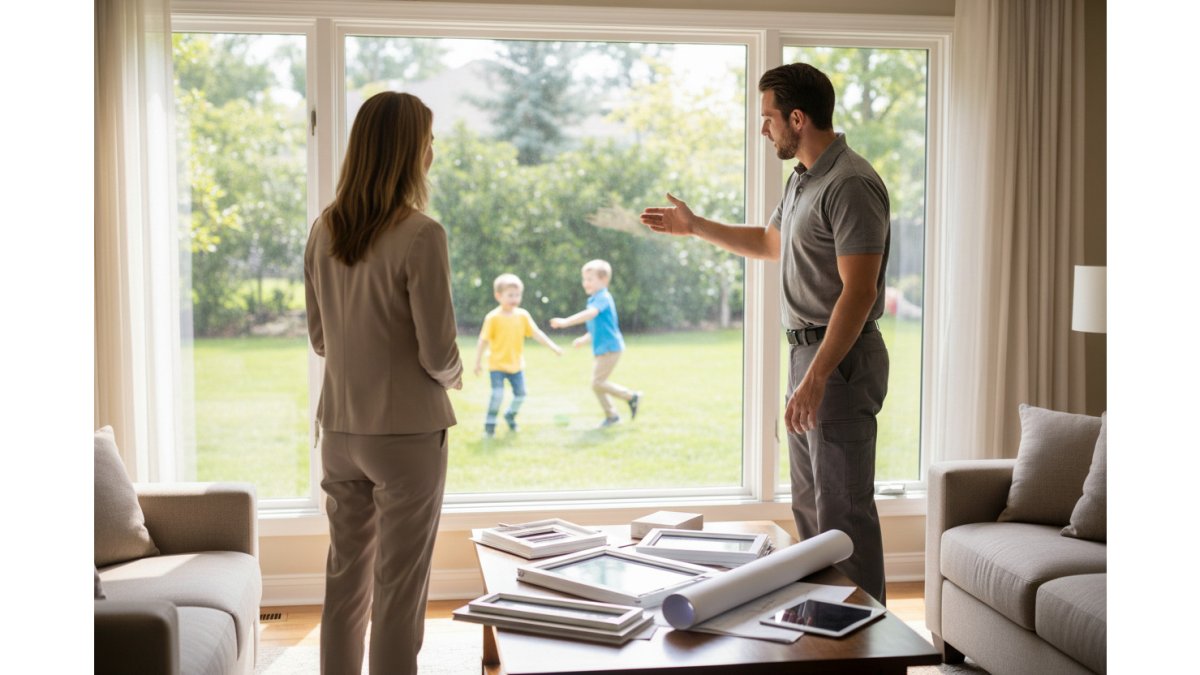
Here's how each stage works:

- Consultation and measurement. We walk the home, inspect each opening, discuss styles and energy options, and measure precisely. This is also when we flag any framing or rot issues.
- Ordering. Windows are built to your measurements, so lead times vary by product line and options.
- Prep. Furniture and flooring near the work area get protected. Old windows come out, and the openings get inspected for hidden damage.
- Installation. New windows are set, shimmed level, insulated, and flashed. Interior and exterior trim is reinstalled or replaced.
- Cleanup and walkthrough. Debris is hauled away, and we walk the finished work with you.
What most guides miss is step three. The condition of the opening behind the old window determines whether the job goes smoothly or becomes a repair project. A crew that inspects carefully protects you from problems later.
How to Compare Window Contractors: A Practical Framework
Most 'how to choose an installer' advice is a list of adjectives: licensed, insured, reputable, experienced. That doesn't help you compare two real bids. This section gives you a scoring framework, the documents to request, and the warranty and permitting questions that separate a professional operation from a crew that disappears after the check clears.
Score every contractor on six criteria
Score every bid on the same six criteria from 1 to 5. A contractor who scores well across all six is a safer bet than one who is strong on price alone.
- Licensing, insurance, and bonding. Ask for the license number, a certificate of insurance showing general liability and workers' compensation, and bonding information. Verify the license with your state or local licensing authority rather than taking a business card at face value. A legitimate contractor provides these without hesitation.
- Installation method. Ask exactly how they will flash the opening, insulate the frame, shim the unit, and seal both the interior and exterior. The answer should be specific. 'We install it to manufacturer spec' is not an answer; ask them to describe the steps.
- Written scope of work. The contract should name the exact brand, model, glass package, and ratings for every window, plus trim work, disposal, cleanup, and who pulls permits. Vague scopes are where change orders come from.
- Warranty coverage. Separate the manufacturer's product warranty from the contractor's labor warranty. Ask for both in writing, and ask what is excluded. More on this below.
- Local reviews and references. Look for reviews from homeowners in your area, and ask for references from projects similar to yours, same window style, same home age, same scope.
- Post-installation support. Ask what happens if a window sticks, a seal fails, or a draft appears in year two. Who do you call, and what is the response commitment?
Warranty: the part most homeowners skip
A window carries two warranties:
- The manufacturer's product warranty covers the window itself, glass seal failure, frame defects, hardware. Terms vary widely by brand and product line, and some prorate coverage over time. Get the actual warranty document, not a summary.
- The contractor's labor warranty covers the installation work, flashing, sealing, trim, and the labor to correct installation defects. This is the warranty that protects you from the most common failure: water intrusion caused by poor installation.
Ask these questions before signing:
- How long is the labor warranty, and what does it cover?
- Is the labor warranty transferable if you sell the home?
- What is excluded, for example, damage from storms, settling, or improper maintenance?
Permits and code compliance
Window replacement generally must meet local building codes and energy-performance standards, but permit requirements vary by jurisdiction, some areas require a permit for replacement windows, others don't, depending on scope and whether the opening is altered.
Ask every contractor:
- Will you pull the permit, and is the fee included in the bid?
- Will the work be inspected, and will I receive documentation of the inspection?
- How do you confirm the windows meet the energy code for this climate zone?
A contractor who shrugs at the permit question or suggests skipping it is a red flag. Unpermitted work can complicate insurance claims, resale, and future repairs.
Compare line by line, not bottom line
The lowest bid isn't always the lowest cost. One quote may include trim replacement, disposal, flashing, and permit fees; another may exclude them and add them later as change orders. Put bids side by side, confirm each line item is comparable, and score each contractor on the six criteria above. The best value covers the full scope at a fair price with documented licensing, insurance, warranty terms, and permit compliance.
Schedule Your Free Window Consultation with Dunn Wright's Exteriors
The best way to get accurate answers on styles, energy ratings, and pricing is an in-home consultation where we measure your actual windows and explain your options. We serve homeowners across Miami and Franklin Counties, and our window consultations are free.
We install ProVia and Polaris windows, offer energy-efficient options, and work with all homeowners insurance companies. If your home was damaged in a storm, we can assist throughout the claims process.
Frequently Asked Questions
How much does professional window installation cost?
Cost depends on window style, size, material, and the number of windows. Dunn Wright's Exteriors offers a free window consultation to review options, energy ratings, and pricing clearly, so you get a number tied to your home instead of a generic range. Factors like double-hung versus awning windows, custom sizes, and whether the frame is replaced all affect the total. Ask for an in-home estimate that lists window cost, labor, disposal, and any trim work separately.
What are the two types of window installation?
The two main methods are full-frame (or full-frame replacement) and pocket (insert) installation. Full-frame replacement removes the entire window, including the frame and trim, and is the better choice when the frame is rotted or you want a different window style. Pocket installation sets a new window into the existing frame, which is faster and less expensive but only works when the frame is sound. A professional installer will check the frame condition before recommending one.
How long does it take to install replacement windows?
Most single-window installations take a few hours, and a whole-house project of 10 to 15 windows typically runs one to three days depending on the installation method and weather. Full-frame replacements take longer than pocket installations because trim and framing are rebuilt. Dunn Wright's Exteriors will outline the expected timeline during your free consultation so you can plan around the work.
Can poorly installed windows affect energy efficiency?
Yes. Gaps around the frame, poor flashing, and compressed insulation let air and moisture in, which undermines even high-performance glass. Energy-efficient windows only deliver their rated performance when installed with proper sealing, alignment, and flashing. That is why contractor selection matters as much as the window brand. Look for licensed, insured installers who follow manufacturer specifications and offer a workmanship warranty.
Ready to stop guessing about cost and performance? Schedule your free window consultation with Dunn Wright's Exteriors and get clear answers on window styles, energy ratings, and pricing for your home.
